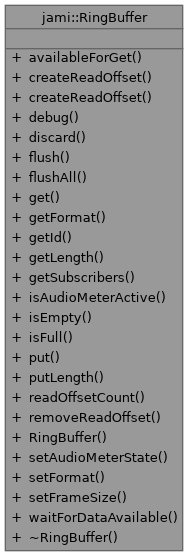
A ring buffer for mutichannel audio samples. More...
#include <ringbuffer.h>
Public Types | |
| using | clock = std::chrono::steady_clock |
| using | FrameCallback = std::function< void(const std::shared_ptr< AudioFrame > &)> |
| using | time_point = clock::time_point |
Public Member Functions | |
| size_t | availableForGet (const std::string &ringbufferId) const |
| To get how much samples are available in the buffer to read in. | |
| void | createReadOffset (const std::string &ringbufferId) |
| Add a new readoffset for this ringbuffer. | |
| void | createReadOffset (const std::string &ringbufferId, FrameCallback cb) |
| void | debug () |
| Debug function print mEnd, mStart, mBufferSize. | |
| size_t | discard (size_t toDiscard, const std::string &ringbufferId) |
| Discard data from the buffer. | |
| void | flush (const std::string &ringbufferId) |
| Reset the counters to 0 for this read offset. | |
| void | flushAll () |
| std::shared_ptr< AudioFrame > | get (const std::string &ringbufferId) |
| Get data in the ring buffer. | |
| AudioFormat | getFormat () const |
| const std::string & | getId () const |
| size_t | getLength (const std::string &ringbufferId) const |
| std::vector< std::string > | getSubscribers () |
| Return the list of subscribers (Ring buffers Id that are reading this ring buffer). | |
| bool | isAudioMeterActive () const |
| bool | isEmpty () const |
| bool | isFull () const |
| void | put (std::shared_ptr< AudioFrame > &&data) |
| Write data in the ring buffer. | |
| size_t | putLength () const |
| Total length of the ring buffer which is available for "putting". | |
| size_t | readOffsetCount () const |
| void | removeReadOffset (const std::string &ringbufferId) |
| Remove a readoffset for this ringbuffer. | |
| RingBuffer (const std::string &id, AudioFormat format=AudioFormat::MONO()) | |
| Constructor. | |
| void | setAudioMeterState (bool state) |
| void | setFormat (const AudioFormat &format) |
| void | setFrameSize (int nb_samples) |
| size_t | waitForDataAvailable (const std::string &ringbufferId, const time_point &deadline=time_point::max()) const |
| Blocks until min_data_length samples of data is available, or until deadline has passed. | |
| ~RingBuffer () | |
| Destructor. | |
Detailed Description
A ring buffer for mutichannel audio samples.
Definition at line 36 of file ringbuffer.h.
Member Typedef Documentation
◆ clock
| using jami::RingBuffer::clock = std::chrono::steady_clock |
Definition at line 39 of file ringbuffer.h.
◆ FrameCallback
| using jami::RingBuffer::FrameCallback = std::function<void(const std::shared_ptr<AudioFrame>&)> |
Definition at line 41 of file ringbuffer.h.
◆ time_point
| using jami::RingBuffer::time_point = clock::time_point |
Definition at line 40 of file ringbuffer.h.
Constructor & Destructor Documentation
◆ RingBuffer()
| jami::RingBuffer::RingBuffer | ( | const std::string & | id, |
| AudioFormat | format = AudioFormat::MONO() |
||
| ) |
Constructor.
- Parameters
-
size Size of the buffer to create
Definition at line 33 of file ringbuffer.cpp.
References jami::emitSignal().

◆ ~RingBuffer()
| jami::RingBuffer::~RingBuffer | ( | ) |
Member Function Documentation
◆ availableForGet()
To get how much samples are available in the buffer to read in.
- Returns
- int The available (multichannel) samples number
Definition at line 213 of file ringbuffer.cpp.
References jami::emitSignal(), and getLength().

◆ createReadOffset() [1/2]
Add a new readoffset for this ringbuffer.
Definition at line 130 of file ringbuffer.cpp.
References jami::emitSignal().
Referenced by jami::AudioLayer::AudioLayer().

◆ createReadOffset() [2/2]
| void jami::RingBuffer::createReadOffset | ( | const std::string & | ringbufferId, |
| FrameCallback | cb | ||
| ) |
◆ debug()
| void jami::RingBuffer::debug | ( | ) |
Debug function print mEnd, mStart, mBufferSize.
Definition at line 95 of file ringbuffer.cpp.
References JAMI_DBG.
◆ discard()
Discard data from the buffer.
- Parameters
-
toDiscard Number of samples to discard
- Returns
- size_t Number of samples discarded
Definition at line 274 of file ringbuffer.cpp.
References jami::emitSignal().

◆ flush()
Reset the counters to 0 for this read offset.
Definition at line 53 of file ringbuffer.cpp.
References jami::emitSignal().

◆ flushAll()
| void jami::RingBuffer::flushAll | ( | ) |
Definition at line 59 of file ringbuffer.cpp.
Referenced by jami::AudioLayer::flush(), jami::AudioLayer::flushUrgent(), and jami::AudioLayer::notifyIncomingCall().
◆ get()
| std::shared_ptr< AudioFrame > jami::RingBuffer::get | ( | const std::string & | ringbufferId | ) |
Get data in the ring buffer.
- Parameters
-
ringbufferId
- Returns
- AudioFRame
Definition at line 220 of file ringbuffer.cpp.
References jami::emitSignal().
Referenced by jami::AudioLayer::getToPlay().

◆ getFormat()
|
inline |
Definition at line 68 of file ringbuffer.h.
◆ getId()
|
inline |
Definition at line 54 of file ringbuffer.h.
◆ getLength()
Definition at line 86 of file ringbuffer.cpp.
References jami::emitSignal().
Referenced by availableForGet().

◆ getSubscribers()
| std::vector< std::string > jami::RingBuffer::getSubscribers | ( | ) |
Return the list of subscribers (Ring buffers Id that are reading this ring buffer).
Definition at line 66 of file ringbuffer.cpp.
References jami::emitSignal().

◆ isAudioMeterActive()
|
inline |
Definition at line 147 of file ringbuffer.h.
◆ isEmpty()
|
inline |
Definition at line 127 of file ringbuffer.h.
References putLength().

◆ isFull()
|
inline |
Definition at line 125 of file ringbuffer.h.
References putLength().

◆ put()
| void jami::RingBuffer::put | ( | std::shared_ptr< AudioFrame > && | data | ) |
Write data in the ring buffer.
- Parameters
-
AudioFrame
Definition at line 163 of file ringbuffer.cpp.
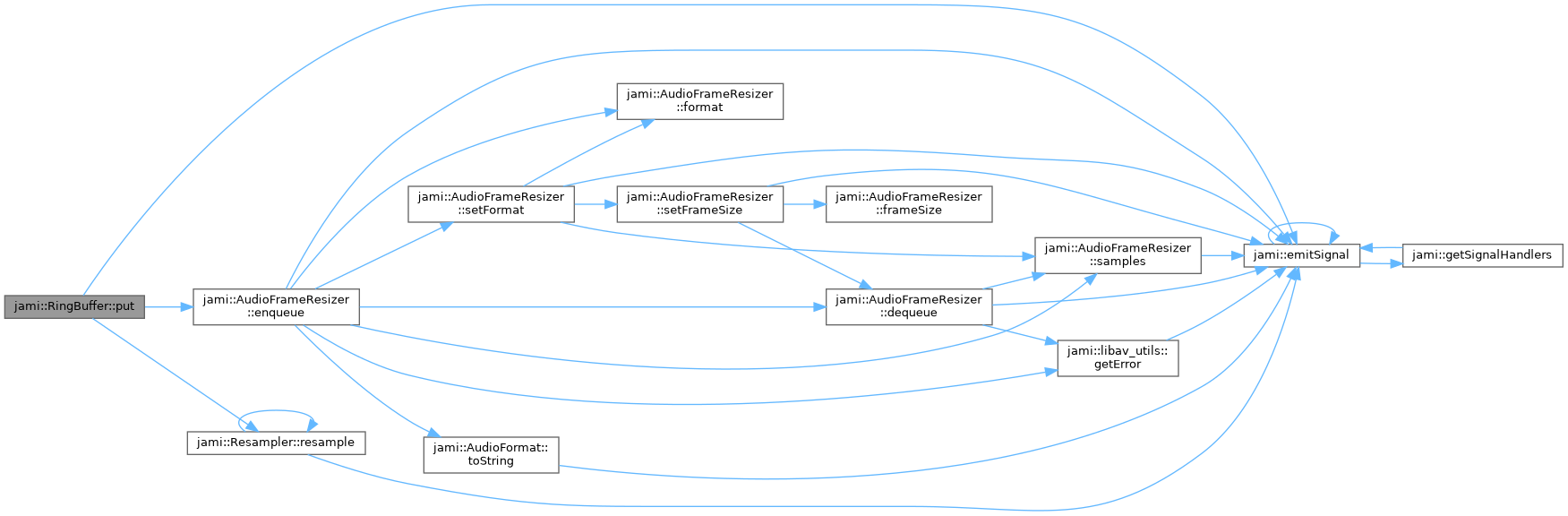
References jami::emitSignal(), jami::AudioFrameResizer::enqueue(), and jami::Resampler::resample().
Referenced by jami::AudioLayer::notifyIncomingCall(), and jami::AudioLayer::putUrgent().
◆ putLength()
| size_t jami::RingBuffer::putLength | ( | ) | const |
Total length of the ring buffer which is available for "putting".
- Returns
- int
Definition at line 76 of file ringbuffer.cpp.
References jami::emitSignal().
Referenced by isEmpty(), and isFull().

◆ readOffsetCount()
|
inline |
Definition at line 89 of file ringbuffer.h.
◆ removeReadOffset()
Remove a readoffset for this ringbuffer.
Definition at line 138 of file ringbuffer.cpp.
References jami::emitSignal().

◆ setAudioMeterState()
Definition at line 148 of file ringbuffer.h.
◆ setFormat()
|
inline |
Definition at line 70 of file ringbuffer.h.
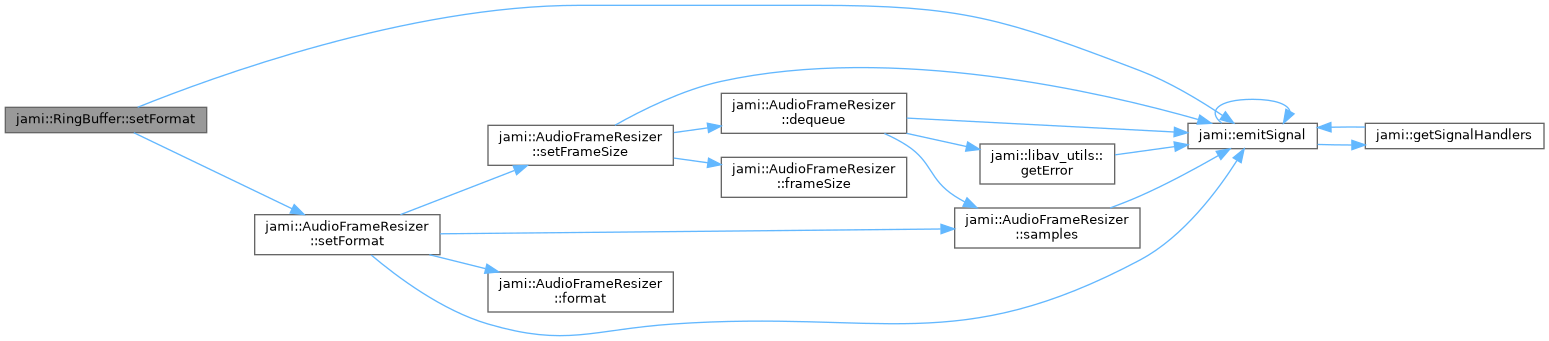
References jami::emitSignal(), jami::AudioFormat::sample_rate, and jami::AudioFrameResizer::setFormat().
Referenced by jami::AudioLayer::hardwareFormatAvailable().
◆ setFrameSize()
Definition at line 129 of file ringbuffer.h.
References jami::emitSignal(), and jami::AudioFrameResizer::setFrameSize().

◆ waitForDataAvailable()
| size_t jami::RingBuffer::waitForDataAvailable | ( | const std::string & | ringbufferId, |
| const time_point & | deadline = time_point::max() |
||
| ) | const |
Blocks until min_data_length samples of data is available, or until deadline has passed.
- Parameters
-
ringbufferId The read offset for which data should be available. min_data_length Minimum number of samples that should be available for the call to return deadline The ringbufferId is guaranteed to end after this time point. If no deadline is provided, the call blocks indefinitely.
- Returns
- available data for ringbufferId after the call returned (same as calling getLength(ringbufferId) ).
Definition at line 243 of file ringbuffer.cpp.
References jami::emitSignal().

The documentation for this class was generated from the following files: